Medicare & Medicaid
Medicare
For nearly 60 years, Medicare has helped pay for medical care for Americans over the age of 65, as well as younger Americans with certain medical needs. Medicare has many different programs, but medicines are covered by two of them—Medicare Part B and Medicare Part D. Part D provides coverage for medicines at retail or mail order pharmacies. Part B covers medications administered by a physician, like injected or infused chemotherapy medications, in locations such as hospital outpatient departments, physician offices, patients’ homes and dialysis centers.
Medicare is administered by the Centers for Medicare & Medicaid Services (CMS), which also includes CMMI, the Center for Medicare and Medicaid Innovation. CMMI was established to test new models for paying for and delivering health care in the Medicare, Medicaid and CHIP programs, such as bundled payments, patient-centered medical homes and accountable care organizations.
While there are many ways Medicare works well, today seniors and people with disabilities are increasingly facing higher out-of-pocket costs for the medicines they need. We must modernize Medicare to make it work even better for seniors and people with disabilities. Read more about our commonsense, patient-centered reforms here.
Medicare
Related Resources
Chart Pack: Medicines in Medicare Part B
To download the full report, click here.
Medicare is the government program that insures many of the nation’s retirees and Americans with disabilities. This chapter contains information on prescription drug coverage under Part B, which generally covers medications administered by a physician, like injected or infused vaccines and medicines. The medicines covered by Part B represent significant medical advances, including breakthroughs in cancer, rheumatoid arthritis, and autoimmune conditions.
Part B
Report
A History of Medicare
For 56 years, Medicare has helped pay for medical care for Americans over the age of 65, as well as younger Americans with certain medical needs. July 30th marks Medicare’s anniversary and to celebrate we are taking a look at the history of the program that benefits more than 60 million Americans.
A History of Medicare image
Medicare
Resource
Medicaid
Medicaid is a state-administered program designed to ensure the most vulnerable in our communities can access the health care services they need. The program is jointly funded by states and the federal government, and it provides health coverage for more than 80 million low-income Americans.
Medicaid
infographic
Affordable Access to Medicines in Medicaid
While the federal government provides general guidelines, each state designs their own Medicaid program and decides whether to provide prescription drug coverage, which is an optional benefit under the program. Biopharmaceutical manufacturers play a critical role in promoting the health of Medicaid beneficiaries and ensuring innovative medicines are affordable for both patients and taxpayers.
Through the Medicaid Drug Rebate Program, manufacturers enter into agreements with the federal government to provide rebates on medicines in exchange for states providing guaranteed access to those medicines in their Medicaid program. The goal is to ensure state Medicaid programs get the lowest net price, saving the states and the federal government money and allowing the program to finance coverage for low-income populations. Additionally, manufacturers can choose to offer supplemental rebates to states as well. This system has worked well over the years, with Medicaid spending on prescription medicines remaining low. In 2022, retail prescription drugs made up just 5.6% of all Medicaid spending, while total rebates from drug manufacturers reached $48.5 billion — a 39% increase from 2017.
Medicaid’s guaranteed coverage also enhances adherence to medicines, which helps individual patients stick to treatment plans outlined by their medical professional. To encourage adherence and to make medicines accessible, Medicaid copayments are capped at $8 and may cost as little as $0 for enrollees with income at or below 150% of the federal poverty level. When patients can better afford their medicines, they are more likely to remain consistent with taking the prescribed doses. Adherence also generates savings for the health care system as a whole by reducing the number of hospitalizations needed.
Access to care provided under Medicaid can also improve health equity. While private insurance is the primary source of coverage across racial and ethnic groups, Medicaid helps to fill gaps in this coverage for underserved communities disproportionately impacted by chronic conditions, like asthma and diabetes. For example, Medicaid provides coverage to 40% of expectant mothers nationwide. For Black Americans and American Indian and Alaska Natives who have higher rates of pregnancy-related mortality, Medicaid coverage jumps to over 66%, and can make a difference in the post-natal outcomes of mothers and babies.
Medicaid in your State
Click your state below to learn more about Medicaid spending data and the value that drugs bring to the Medicaid program and patients.
LEARN MORE ABOUT MEDICAID SPENDING ACROSS THE ENTIRE UNITED STATES
Click the button below to download a PDF for Medicaid in
This report is not yet available.
Alabama
AL
Alaska
AK
Arizona
AZ
Arkansas
AR
California
CA
Colorado
CO
Connecticut
CT
Delaware
DE
District of Columbia
DC
Florida
FL
Georgia
GA
Hawaii
HI
Illinois
IL
Indiana
IN
Iowa
IA
Kansas
KS
Kentucky
KY
Louisiana
LA
Maine
ME
Maryland
MD
Massachusetts
MA
Michigan
MI
Minnesota
MN
Mississippi
MS
Missouri
MO
Montana
MT
Nebraska
NE
Nevada
NV
New Hampshire
NH
New Jersey
NJ
New Mexico
NM
New York
NY
North Carolina
NC
North Dakota
ND
Ohio
OH
Oklahoma
OK
Oregon
OR
Pennsylvania
PA
Puerto Rico
PR
Rhode Island
RI
South Carolina
SC
South Dakota
SD
Tennessee
TN
Texas
TX
Utah
UT
Vermont
VT
Virginia
VA
Washington
WA
West Virginia
WV
Wisconsin
WI
Wyoming
WY
Medicaid
Click the button below to download a PDF for Medicaid in
https://cdn.aglty.io/phrma/fact-sheets/medicaid/Medicaid State Fact Sheets_Alaska_20260821032809.pdf
https://cdn.aglty.io/phrma/states/Medicaid State Fact Sheets_Georgia_20260824105416.pdf
https://cdn.aglty.io/phrma/fact-sheets/medicaid/Medicaid State Fact Sheets_Hawaii_20260821034703.pdf
https://cdn.aglty.io/phrma/fact-sheets/medicaid/Medicaid State Fact Sheets_Iowa_20260821035024.pdf
https://cdn.aglty.io/phrma/fact-sheets/medicaid/Medicaid State Fact Sheets_Kansas_20260821035133.pdf
https://cdn.aglty.io/phrma/fact-sheets/medicaid/Medicaid State Fact Sheets_Maine_20260821035444.pdf
https://cdn.aglty.io/phrma/fact-sheets/medicaid/Medicaid State Fact Sheets_Ohio_20260821042132.pdf
https://cdn.aglty.io/phrma/fact-sheets/medicaid/Medicaid State Fact Sheet_Oregon_20260821042315.pdf
https://cdn.aglty.io/phrma/fact-sheets/medicaid/Medicaid State Fact Sheet_Texas_20260821042802.pdf
https://cdn.aglty.io/phrma/fact-sheets/medicaid/Medicaid State Fact Sheet_Utah_20260821042841.pdf
https://cdn.aglty.io/phrma/fact-sheets/medicaid/Medicaid State Fact Sheet_Vermont_20260821043030.pdf
https://cdn.aglty.io/phrma/fact-sheets/medicaid/Medicaid State Fact Sheet_Wyoming_20260821043527.pdf
Protecting Access to Medicines in Medicaid
Medicaid is meant to ensure all Americans, no matter their socioeconomic status, can access health care. Any policies put in place at either the federal or state level must ensure that access is maintained. The Medicaid Drug Rebate Program (MDRP) plays a vital role in ensuring the financial sustainability of Medicaid and providing access to needed medicines for millions of Americans. Unfortunately, the federal government has proposed changes that could put that security of the program at risk.
There has also been an increase in improper use of prior authorization, creating hurdles for Medicaid participants and limiting their ability to access needed care. This misuse interferes with the doctor-patient relationship by preventing providers from selecting the best medicine for each patient’s individual circumstances.
Related Resources
Medicaid by the Numbers
Medicaid is a state-administered program designed to ensure the most vulnerable in our communities can access the health care services they need. This safety-net program is jointly funded by states and the federal government, and it provides health care coverage for millions of Americans.
Medicaid by the Numbers image
Medicaid
Fact Sheet
Providing affordable access to medicines in Medicaid
As we near the end of Medicaid Awareness Month, we wanted to acknowledge that Medicaid is one of the nation’s most important safety-net programs. This federal-state partnership provides health care coverage to more than 80 million individuals. What many don’t know is that biopharmaceutical manufacturers play a critical role in helping state Medicaid programs provide affordable access to medicines under the Medicaid Drug Rebate program (MDRP).
While the federal government provides general guidelines, each state designs their own Medicaid program and decides whether to provide prescription drug coverage. To help states provide robust access to medicines, manufacturers enter into a national rebate agreement with the Secretary of HHS (on behalf of states). Under the agreement, states agree to provide access to all of a manufacturer’s medicines and in exchange, manufacturers provide significant rebates based on Medicaid drug utilization. The goal of the MDRP was to ensure Medicaid received a price at least as low as the price given to a manufacturer’s “most favored customer,” thus helping keep costs down for state governments and patients. Today the system is still working.
All states offer prescription drug coverage today, and Medicaid spending on medicines remains low. In 2022, retail prescription drugs made up just 5.6% of all Medicaid spending. This is largely due to the $48.5 billion in rebates manufacturers provided — a 39% increase from 2017.
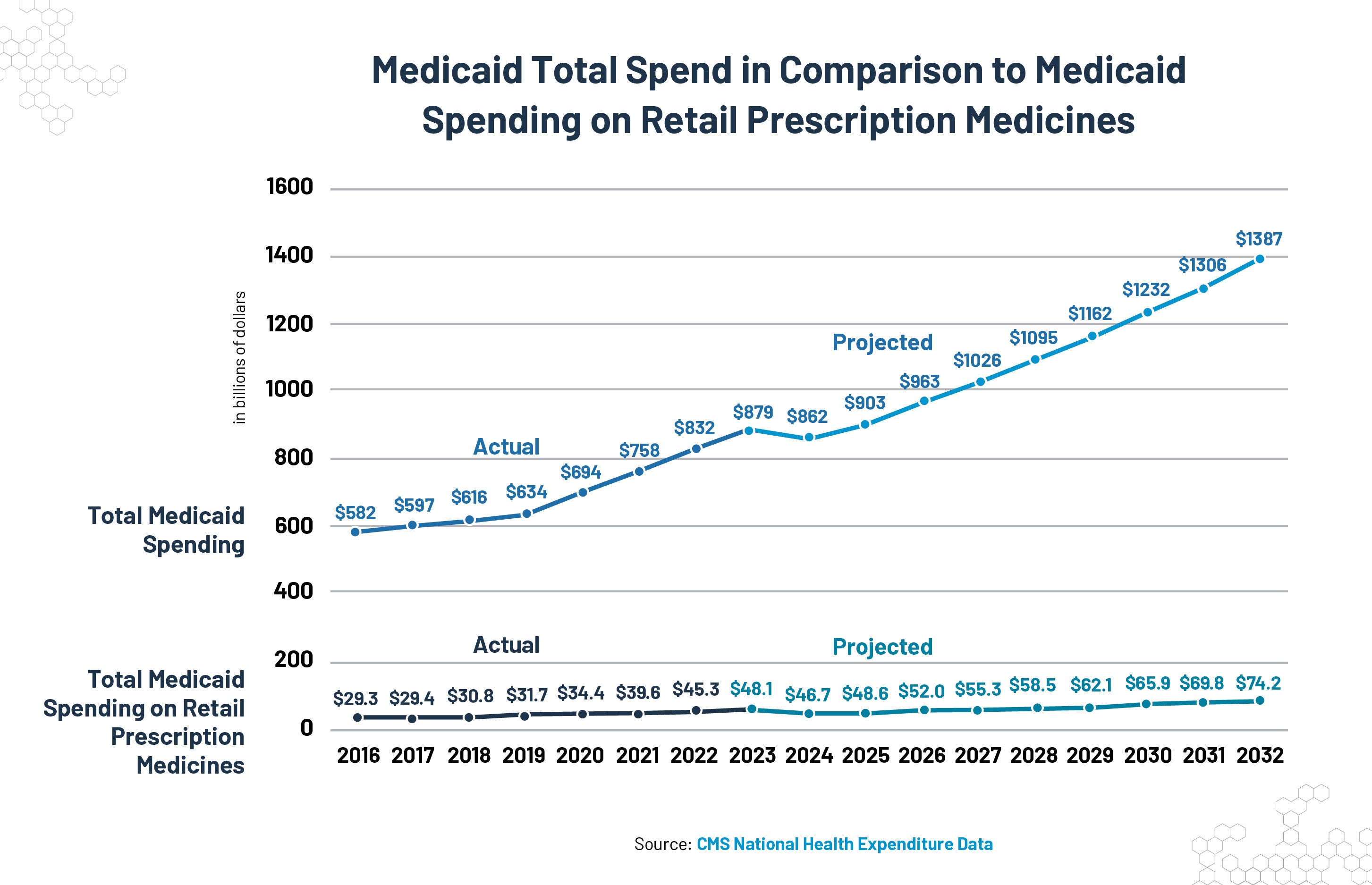
Due in part to the rebates provided by biopharmaceutical companies, Medicaid enrollees access medicines that they might not otherwise be able to, meaning that patients are less likely to avoid getting the care they need. And because Medicaid primarily focuses on individuals with low incomes, there are low or no copays. Without the program, many enrollees could not afford their lifechanging medicines.
The industry is committed to delivering new, innovative medicines and working with policymakers to ensure they are accessible and affordable for patients through programs like Medicaid.
Nicole Longo
Providing affordable access to medicines in Medicaid
Manufacturers provided $42 billion in Medicaid discounts in 2021 alone
Biopharmaceutical manufacturers offset the cost of prescriptions through the Medicaid Drug Rebate Program, ensuring access for millions of Americans like children and their parents, pregnant women, the elderly and people living with disabilities who participate in a state Medicaid program.
Why it matters: In federal fiscal year 2021, the $42 billion in discounts manufacturers provided represented 56% of total Medicaid medicine spending in the United States. These savings enabled states and the federal government to reinvest back into the program, better serving the 87 million vulnerable Americans who rely on it.
What's new: Recently released Medicaid state factsheets provide a detailed cost breakdown for how Medicaid spends its budget in all 50 states and the District of Columbia. Here are some examples:
- California received $4.8 billion in rebates from manufacturers, allowing the state to spend a mere 3.7% of their total Medicaid budget on retail prescription medicines.
- Maine’s Medicaid program received manufacturer rebates representing 71% of its total Medicaid retail prescription medicine spending.
- Nebraska spent only 2.7% of its total Medicaid budget on retail prescription medicines because of rebates from manufacturers.
Unfortunately, some states are limiting access to lifesaving brand medicines in Medicaid by imposing barriers on medicines for patients or restricting how many prescriptions patients can fill each month. And at the federal level, CMS has proposed sweeping policy changes to the Medicaid Drug Rebate Program, many of which are not grounded in the Medicaid statute and would go beyond CMS’ legal authority. These policies will lead to poorer health outcomes for already vulnerable populations and contribute to higher costs across the health care system.
Medicaid provides Americans across the country with access to needed medications with low to no cost sharing, improving health equity and access to medicines nationwide. Policymakers should protect that robust access. Read the factsheets and learn more about policy solutions in all 50 states.
Gabby Migliara
Manufacturers provided $42 billion in Medicaid discounts in 2021 alone
Chart Pack: Medicines in Medicaid
To download the full report, click here.
Medicaid provides health insurance for 1 in 5 vulnerable Americans, including children, pregnant women, seniors, and those with serious diseases, providing them with access to needed medications with low to no cost sharing
Medicines in Medicaid
Report
CMS should rethink proposed changes to the Medicaid Drug Rebate Program | PhRMA
In comments submitted last week, PhRMA cautions CMS about sweeping policy changes to the Medicaid drug rebate program, many of which are not grounded in the Medicaid statute and would go beyond CMS’ legal authority. At a time when providers, pharmacies, wholesalers and manufacturers are busy preparing for major policy changes like the average manufacturer’s price cap removal, Part D redesign, and the IRA’s price setting provisions – which all impact Medicaid – these proposed changes would be extremely disruptive if finalized.
Among the concerns outlined in our comment letter, the following rise to the top:
- The proposed "stacking” policy, which would change the calculation of best price, is inconsistent with the statute and would be operationally unworkable. The policy would require manufacturers to add up all the rebates and discounts for a unit of a medicine provided to best price-eligible entities across the entire supply chain, like pharmacies, wholesalers or providers. This new ‘best price’ based on stacking all the rebates and discounts is not a price that is actually available to any entity in the supply chain today.
- The proposed change to the “covered outpatient drug” definition would make a significant change to the Medicaid drug rebate program. Congress carefully defined covered outpatient drug when creating the Medicaid drug rebate program. This change takes the “outpatient” meaning out of “covered outpatient drug” — essentially undoing a definition that is decades old and contradicting what Congress intended.
- The proposal for a burdensome “price verification survey” does not do anything to verify the accuracy of prices reported to CMS as the rule claims. The survey would instead target manufacturers of the most innovative therapies, including cell and gene therapies, that fill a critical need in the vulnerable populations that Medicaid serves. It seeks a broad array of data – much of which is proprietary – that has nothing to do with verifying manufacturer prices reported under Medicaid. This is CMS’s not-so-veiled attempt to extract additional rebates from manufacturers without authority to do so.
The Medicaid drug rebate program plays a vital role in ensuring the financial sustainability of Medicaid and providing access to needed medicines for millions of Americans. Manufacturers pay mandatory rebates in exchange for guaranteed coverage of their FDA-approved medicines. CMS’s proposed changes far exceed the agency’s authority and jeopardize the careful balance struck by Congress in the Medicaid drug rebate statute.
Read our full comments.
Gabby Migliara
CMS should rethink proposed changes to the Medicaid Drug Rebate Program | PhRMA
New calculator demonstrates how improved adherence to anti-diabetic medicines can benefit people in Medicaid
Diabetes is a scary diagnosis for anyone. When people with the disease struggle to manage their blood sugar levels, they can experience significant, life-threatening and costly complications such as heart attack, stroke, kidney failure, amputation and blindness. Fortunately, diabetes can be well-managed with comprehensive access to health care services, including medicines.
To that end, PhRMA recently partnered with GlobalData to demonstrate how, when people with diabetes enrolled in Medicaid are not able to adhere to their treatment regimen, it affects their health outcomes. The tool GlobalData created — known as the Medicaid Diabetes Adherence Online Tool — demonstrates how states can avoid costly medical complications if adherence to anti-diabetic medicines is improved over six years. Specifically, the tool provides analyses that show differences in the impacts diabetes has on various communities, as well as opportunities to improve health equity and reduce health costs, by race, ethnicity and age.
The new tool is being shared with the goal of helping policymakers and health care professionals to find ways to improve adherence to anti-diabetic medication among Medicaid beneficiaries. The following statistics highlight areas to be addressed:
While diabetes is a chronic condition that can be managed, the burden of the disease falls disproportionately on communities of color.
- Diabetes disproportionately affects American Indians/Alaska Natives (14.7%), Hispanics (12.5%) and non-Hispanic Blacks (11.7%) compared to White populations. Communities of color are also more likely to experience complications from diabetes. The rate of diabetes-related deaths among Native Americans/Alaska Native populations is 2.3 times higher than non-Hispanic Whites, and Hispanics are 1.3 times more likely to die from diabetes than non-Hispanic Whites.
- Communities of color are also less likely to receive recommended diabetes preventive care, such as hemoglobin A1c (HbA1c) testing, annual cholesterol screening and retinal examination.
Because so many people with diabetes are covered by Medicaid, access to care through Medicaid plays an important role in helping individuals manage their disease.
- An estimated 12% of Medicaid enrollees have diabetes, and Medicaid is estimated to cover 15% of all individuals with the disease.
Despite the low cost of medicines in Medicaid, enrollees take their medication as prescribed only about 75% of the time.
- Medicines in Medicaid have limited cost sharing from $1-$4, and rebates from manufacturers help to offset costs for states and the federal government. Despite these limited costs, some enrollees continue to face access barriers.
+++
The new Medicaid Diabetes Adherence Calculator provides a visual comparison across 50 states and Washington, D.C. To use the tool, click here. For more information about Medicaid, please visit www.PhRMA.org/Medicaid. See more resources geared toward policy solutions in all 50 states at www.PhRMA.org/States.
Reid Porter
New calculator demonstrates how improved adherence to anti-diabetic medicines can benefit people in Medicaid