Inequities in health care are often rooted in community-level factors like where we live, work, and play; lack of adequate coverage and access to providers; and systemic racism and discrimination. For example, 28% of adults living in rural areas lack access to broadband internet, nearly half of the households in Native communities (48%) lack access to reliable clean water and over 40% of US counties are pharmacy deserts, where most people have to drive more than 15 minutes to reach nearby pharmacies. These factors influence how patients interact with the healthcare system and can significantly impact their ability to access and adhere to necessary medications and treatment.
To illuminate factors impacting patients' ability to access life-saving medicines, PhRMA created a Social Determinants of Health (SDOH) simulation designed to allow users to walk through a patient’s journey and experience the role structural and social factors play.
Access and adherence to medicines are key drivers of improving patient health outcomes and can significantly reduce health care costs. Nationally, $3.8 trillion could be saved in reduced medical costs and lost work productivity if the U.S. health care system committed to providing evidence-based health care guidelines and tools to empower patients in communities of color and committed to redressing social and structural determinants of health, including:
- disproportionate impact of insurance design scheme
- access to preventative care and timely screenings
- pharmacy deserts in their communities
One study estimates that differences in colorectal cancer screening rates are responsible for 19% of the disparity in colorectal cancer deaths between Black and white patients. Evidence has shown that the downstream consequences of the inability to access health care and maintain treatment plans include increased health care costs, poor health outcomes and increased risk of mortality. These intersecting systemic social and structural barriers drive disparate health outcomes.
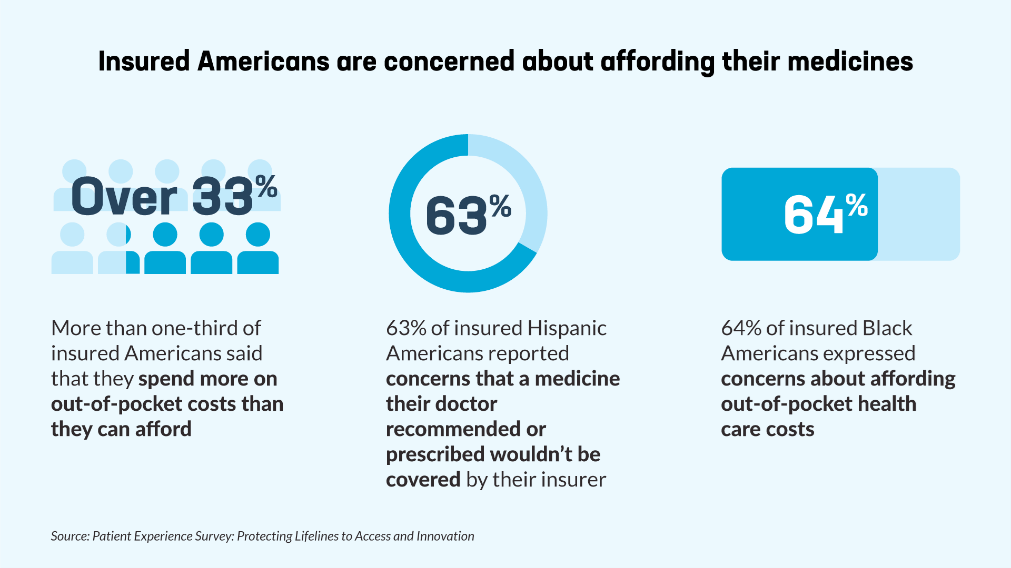
Further, in a recent PhRMA survey, more than one-third of insured Americans said that they spend more on out-of-pocket costs than they can afford, 63% of insured Hispanic Americans reported concerns that a medicine their doctor recommended or prescribed wouldn’t be covered by their insurer and 64% of insured Black Americans expressed concerns about affording out-of-pocket health care costs.
Poor insurance coverage reduces access to care, including the ability to receive a prescription from a health care provider and fill it at the pharmacy. Recent research has shown that Black Americans (24%) and Hispanic Americans (21%) with insurance are much more likely to report that they would not be able to afford their out-of-pocket costs if they had a major medical event or became seriously ill, compared to 17% of white Americans.
These factors only reflect a fraction of the effects of social determinants of health. PhRMA’s new simulation sheds light on these drivers of health outcomes that patients of diverse abilities, race and economic status face. Explore the simulation and what stands between a patient and their medicines: https://phrma.org/Equity/SDOHandMedicines
Kristin Williams
Kristin Williams is a Senior Manager of Policy and Research at PhRMA, supporting public policy analysis and research on issues related to health equity and prescription drug coverage. Recently, she received her Master of Public Health in Health Policy from The George Washington University. She is committed to helping develop equitable solutions to address disparities in health outcomes and access to care among marginalized populations.
Kristin Williams
Recent events highlight progress on health equity
ICYMI: PhRMA’s 4th Annual Pathways to Success: Virtual STEM Career Expo
Hispanic Heritage Month: Fighting for Hispanic patients
PhRMA awards grants to 2024 Annual Pathways to Success: Virtual STEM Career Expo Partners
How government price setting fails to address systemic health care inequities
Women’s Health Month: A conversation with Sage
Championing cancer equity: Our drive for healthier AANHPI communities
New analysis: Accelerated approval pathway is changing lives in underserved communities
PhRMA provides grant funding to support the Morehouse School of Medicine Satcher Health Leadership Institute’s Health Equity Tra
PhRMA awards grants to 2023 Annual Pathways to Success Graduate Summit Partners
Between hope and despair: Improving cancer outcomes
PhRMA awards grant to Emerson Diversity Health Foundation
PhRMA Otorga Beca a la “Emerson Diversity Health Foundation”
Using traditional HTAs to determine coverage threatens patient access to medicine
Traditional HTAs keep diverse patients out of the conversation
Traditional HTA methods treat everyone like the “average” patient
You won’t fix what you don’t value: Two reasons why traditional cost-effective analyses can perpetuate health inequities
Potential gene therapies bring hope to patients with sickle cell disease
Stephanie Dyson of BMS on reducing health disparities
Sharing rebates can save Americans with diabetes 500 each year and improve adherence
Announcing CAREs Grant Round 4
Announcing CAREs Grant Round 4
Guest Series: PhRMA talks racial and health equity with Lauren Powell, VP US Health Equity and Community Wellness, Takeda
PhRMA awards $75,000 to fund initiatives to reduce health inequities
Watch: Building trust and enhancing clinical trial diversity
More than 800 medicines are in development for diseases that disproportionately affect racial and ethnic communities
PhRMA hosts first stakeholder workshop on clinical trial diversity
PhRMA CAREs Grant request for proposals: Addressing inequities in access to COVID-19 testing, therapeutics and vaccines
PhRMA member companies share how they are improving clinical trial diversity
Guest post: PhRMA talks racial and health equity with Stephanie Dyson, Head of Office at Biogen
Paper finds gaps in health data are a barrier to health equity
New research shows hotspots of inequity relate to increased COVID-19 hospitalizations
Increasing diversity at investigator sites could increase minority participation in clinical trials
Report highlights biopharmaceutical industry’s commitment to D&I
Strengthening a culture dedicated to patients and equity: A conversation with Percival Barretto-Ko, President of Astellas US
PhRMA CAREs Grant request for proposals: Addressing racial disparities in medication utilization and adherence
Committing to diversity, equity and inclusion: A call to action for clinical trials
Just released: PhRMA members’ new clinical trial diversity principles
ICYMI: Addressing health inequities: Biopharmaceutical companies are rising to the occasion
Guest Post: Honoring Hispanic Heritage Month by taking action on health equity
Sharing rebates can improve access to medicines and increase health equity
PhRMA will continue to advocate for equity within our industry
Three ways the pharmaceutical industry can positively impact health equity
Guest Post: Amgen Foundation stands for equal opportunities in STEM learning
Systemic racism is as real as any disease, and our industry is not immune
Guest Post: Pride started with protest: Combatting the dual pandemics of COVID-19 and racism this Pride Month
PhRMA awards $100,000 to fund projects that address health inequalities
Observing National Minority Health Month in the age of COVID-19
New social determinants of health simulation explores structural barriers patients face accessing and affording medicines
Health Equity
New social determinants of health simulation explores structural barriers patients face accessing and affording medicines
New social determinants of health simulation explores structural barriers patients face accessing and affording medicines