New data show insurers and middlemen known as pharmacy benefit managers (PBMs) are making it harder for patients to get the medicines they need.
- Patients increasingly face access restrictions to their medicines. Insurers and PBMs use what’s known as utilization management restrictions as a strategy to reduce their spending on medicines, but they can have an adverse impact on patient access. These insurance tactics include prior authorization and fail first requirements (also known as step therapy) and often prevent or delay patients from accessing the medicines they need. A recent analysis by Avalere Health looked at commercial insurers’ use of utilization management for single-source brand medicines across 12 therapeutic areas and found that from 2014 to 2020, these types of restrictions increased across all 12 therapeutic areas, which included cancer, depression, rheumatoid arthritis and diabetes.
Increase in Use of Utilization Management in the Commercial Market from 2014 to 2020
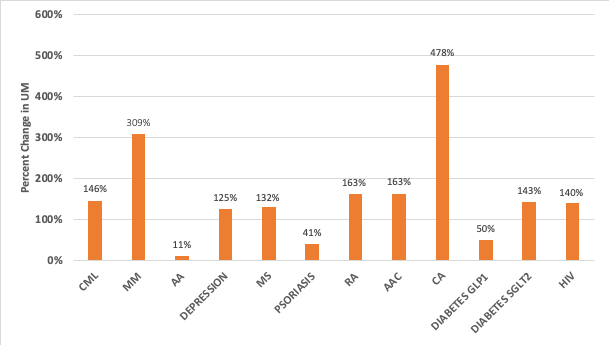
Note: Samples include single-source brand medicines in each therapeutic area
Source: Avalere, Increase in Utilization Management Use for Single-Source Brand Medicines in the Commercial Market from 2014 to 2020
- Fail first requirements are pervasive across commercial health insurance plans. A recent study published in Health Affairs found that a significant share of commercially insured patients taking medicines face step therapy restrictions, where patients must try and fail on one or more medicine preferred by their insurer and PBM before the originally prescribed medicine is covered. In fact, more than half of fail first policies developed by health plans were found to be more restrictive than recommended clinical guidelines, meaning patients and providers may have to overcome time-consuming hurdles before a medicine is covered. The researchers concluded that “[t]hese findings raise questions about potentially overly restrictive step therapy protocols, as well as concerns that variability across health plans makes protocols onerous for patients and practitioners alike.”
- Access restriction trends in the commercial market also exist in Medicare Part D. A recent report from GoodRx found that the average number of medicines covered by Part D that are subject to utilization management restrictions increased from 27% in 2010 to 47% in 2021. This confirms previous research published by MedPAC that found Medicare beneficiaries now face access barriers for nearly half of all medicines covered in Part D.
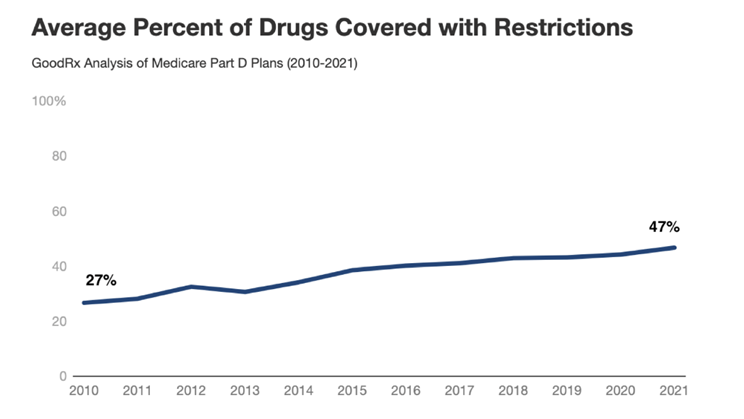
Source: GoodRx, THE BIG PINCH: Findings on Changing Insurance Coverage of Prescription Drugs
These trends are especially concerning considering recent research that shows utilization management restrictions are more likely to affect the sickest and most vulnerable patients in our health care system.
Unfortunately, government price-setting policies currently being considered by Congress threaten to exacerbate these challenges. These policies will ultimately lead to even less access to innovative medicines, while letting health plans and PBMs off the hook for raising costs on patients and restricting access to life-saving treatments.
America’s biopharmaceutical research industry is ready to do its part to help ensure all patients can access the medicines they need. We support patient-centered, bipartisan solutions like making insurance work like insurance by covering more medicines from day one, making out-of-pocket costs more predictable and sharing negotiated savings with patients at the pharmacy counter.
Learn more at PhRMA.org/BetterWay.
Katie Koziara
Katie Koziara is Senior Director of public affairs at PhRMA focusing on the organization’s executive visibility work and media relations strategy. She previously ran the social media strategy for a D.C.-based non-profit working on federal management and leadership issues. Katie earned her B.A. in Public Policy from the University of Michigan’s Ford School and is currently earning her M.A. in Fiction Writing from Johns Hopkins University.
Katie Koziara
Medicare Part D at 20: Building on a strong foundation
The IRA’s price setting doesn’t guarantee lower costs or better access
What seniors can expect this open enrollment
Part D premiums are going up, while choices are going down
Medicare Part D plans initially denied medicines for more than 70% of patients in four chronic disease areas
PBMs launch new ad campaign to block reforms
Patients are losing as government price setting continues
CMS needs to do better
Is CMS paying attention to the growing access barriers for Medicare patients under the IRA?
The Inflation Reduction Act could increase costs and reduce access for millions of seniors
New survey: Insurers confirm IRA will reduce patient treatment options
The unintended consequences of government price setting in Medicare Part D
What is the low-income subsidy program and how is it changing?
The IRA could lead to higher out-of-pocket costs for 3.5 million Medicare patients in 2026
IRA is already negatively impacting access to medicines in Part D
New study finds insurers and PBMs increasing access restrictions in Medicare Part D
ICYMI: 3 takeaways on the IRA’s unintended consequences from America’s Physician Groups’ 2023 annual fall conference
ICYMI: Government watchdog report finds patients in Medicare Part D paid billions more for medicines than insurers and PBMs
IRA threatens seniors’ access to robust treatment options
Medicare Prescription Payment Plan will benefit patients if implemented correctly
Correcting the record: IRA’s government price setting provisions are unconstitutional
IRA changes to Part D risk access to medicines
With the first list of medicines out, let’s not forget why government price setting is bad policy
One year later IRAs unintended consequences are becoming reality
Four things for CMS to keep in mind as they implement changes to Part D
CMS guidance on IRA price setting process doubles down on bad policy
Medicare Part D open enrollment and what recent changes mean for beneficiaries
Many seniors are paying more for Part D medicines than their insurer
A key fact the White House is reluctant to admit
A key fact the White House is reluctant to admit
The Senate’s latest price setting proposal will undermine: Patient access to medicines
Three charts show how the Medicare Part D program could be improved to work better for seniors and people with disabilities
Part D 101: Three charts show how the program provides comprehensive prescription drug coverage
New comments outline ways to counteract cost-shifting insurance trends
It’s a new year, but sadly Congress is still pursuing flawed price setting policies
Post-approval research save lives. Why is Congress trying disincentivize it?
A price control by any other name would still put patients at risk and threaten innovation
Making medicines more affordable: Modernizing Medicare
ICYMI: New study confirms policies like H.R. 3 could significantly reduce drug development
America’s biopharmaceutical companies to Congress: Government “negotiation” is the wrong approach
Recent polling misrepresents public support for Medicare “negotiation”
What they’re saying: Patient advocates want to protect Medicare from government interference
Myth vs. fact: Polling and Medicare “negotiation”
ICYMI: Event spotlights how we can make Medicare work better for patients
The future of the rebate rule: Will policymakers stand with patients?
Celebrating Medicare’s 56th anniversary
Government “negotiation” could have devastating consequences for Medicare enrollees
Protecting Medicare from government interference
Data shows voters strongly support protecting access to their medicines
Medicare “negotiation” proposals threaten Americans’ access to medicines
Out-of-pocket trends in Medicare Part D show rising costs for seniors
The ABCs (and Ds) of Medicare
ICYMI: Bipartisan lawmakers urge new administration to oppose changes to six protected classes policy
Key excerpts: PhRMA submits comments to keep the six protected classes protected
Action needed to preserve the six protected classes
Key facts: The final rebate rule will be a positive change for patients
End of year Part D reading List
Final rebate rule represents right way to change Medicare
Open Enrollment: How to find a Medicare plan that meets your needs
Three reasons why repealing the Part D non-interference clause is a bad idea
National Medicare Education Week: The history of Medicare Part D
How Medicare Part D supports patients
Supporting access to vaccines for Part D beneficiaries
Medicare’s 55th anniversary: Celebrating the success of Part D
Three reasons why MedPAC’s latest Part D proposal would be bad for patients
PhRMA submits comments on CMS’s Part D specialty tier proposal
Three reasons the Senate Finance package is the wrong approach for patients
Three things to know about the Part D GAO report
No matter how you structure it, government arbitration is wrong for Medicare drug coverage
What you should know: Government arbitration is the wrong way to change Medicare
How the rebate rule would help reduce patients’ out-of-pocket costs
Ask About Adherence: OIG proposed rule to reform the rebate system could improve adherence
4 Things to know about the IQVIA “Medicine Use and Spending” report
Event tomorrow: Improving access and affordability for America’s seniors
Six policy solutions to help patients afford their insulin
PhRMA comments on OIG proposed rule to reform the rebate system
Rebate rule would help ensure seniors with diabetes don’t pay more for their medicine than their insurer
Bipartisan lawmakers urge Administration to rethink proposed changes to six protected classes policy
OptumRX: Sharing rebates with patients is “worth it”
Changes to the six protected class policy are the wrong prescription for Medicare and HIV patients
New “Prescription for Medicare” campaign focuses on impacts of wrong and right solutions for Medicare
Repealing Part D noninterference clause threatens access and choice for America’s seniors
New study shows why insurers should share rebates with Medicare Part D beneficiaries on a mandatory basis
PhRMA comments to administration on Medicare Part D proposed rule
New research shows changes to the six protected classes would harm most vulnerable patients and are unnecessary
Keep the Six Protected Classes, protected
Experts agree: the Bipartisan Budget Act changes to Medicare Part D jeopardize the program
What if a couple of small fixes could protect seniors in the donut hole and save them money on out-of-pocket costs?
PhRMA submission to HHS on blueprint to lower drug prices and reduce out-of-pocket costs
Pass-through rebates do not violate non-interference clause but they do increase savings for seniors
Medicare Part D cliff ahead
Part D cliff looms for seniors, as program stability could be in jeopardy
New “Let’s Talk About Medicare” campaign focuses on solutions to improve affordability and predictability for seniors in Part D
ICYMI: Two PBM reports show dramatic slowdown in medicine spending growth
PhRMA urges CMS to share the savings with seniors
Medicare Monday: Helping beneficiaries access vaccines
Medicare Monday: Same bad ideas continue to threaten Part D and beneficiary access to medicines
Medicare Monday: Open enrollment is here again
Medicare Monday: Medicare Part D by the numbers
Medicare Monday: What is the Extra Help program?
Medicare Monday: Strengthening access to vaccines for seniors
Medicare Monday: Part D premiums expected to drop in 2018
Medicare Monday: Medicare turns 52!
Medicare Monday: What you need to know about the latest Medicare Trustees report
Medicare Monday: Study finds mortality rates for elderly have decreased every year since creation of Part D
Medicare Monday: It is Medicare’s birthday month!
Medicare Monday: 3 reasons why repealing Part D’s noninterference clause is a bad idea
Medicare Monday: How government price setting in Part D could reduce innovation, shorten life expectancy for beneficiaries
Medicare Monday: Positive impact of Part D on America’s seniors
Medicare Monday: Why imposing Medicaid-style rebates in Part D is a bad idea
Medicare Monday: Another example of the competitive market at work in Part D
Medicare Monday: A discussion on affordability and access to medicines
Medicare Monday: New study further confirms increased use of generics after Part D
Medicare Monday: Did you know … ?
Medicare Monday: How Part D helps patients with heart disease live longer, healthier lives
Medicare Monday: How Medicare helps beneficiaries access needed medicines
Medicare Monday: A refresh on private negotiation in Part D
Medicare Monday: Kicking off 2017 with Medicare resources
New data show insurers and PBMs increase barriers to care
Affordable Care Act
Part D
New data show insurers and PBMs increase barriers to care
New data show insurers and PBMs increase barriers to care