Drug Shortages
Understanding Prescription Drug Shortages
PhRMA member companies are committed to developing safe and effective medicines for patients. Ensuring patients can get their medicines when they need them through resilient and secure supply chains is critical. Our industry works closely with the U.S Food and Drug Administration (FDA), supply chain partners and health care providers to maintain robust supply chains and prevent and mitigate drug shortages.
Our members make significant and sustained investments in the design and maintenance of all aspects of their supply chains while preparing for unforeseen events through robust, adaptable business continuity plans. This helps ensure biopharmaceutical manufacturers can meet the needs of patients, prescribers, health care facilities and public health authorities who depend on their medicines.
Analysis: America is an API powerhouse
Overview
About 70%
the proportion of drug shortages in the United States comprised by generic drugs
40% of generic drugs
were supplied by only one manufacturer, and the median number of manufacturers per drug was just two
More than 85%
by dollar of active pharmaceutical ingredients were produced in either the United States (53%) or Europe (33%)
Why Prescription Drug Shortages Occur
Drug shortages can occur for a variety of reasons and at a variety of points throughout the prescription drug supply chain. This can include manufacturing quality issues, production or possible delays in receiving raw materials and other components from suppliers. Disruptions from natural disasters and public health emergencies also contribute. Beyond these core factors, workforce challenges, manufacturing infrastructure and policies in the Inflation Reduction Act could increase drug shortages. Generic drugs are particularly susceptible to drug shortages due to persistent economic challenges facing the generic industry.
Why Shortages Happen
Preventing and Mitigating Shortages
Our industry is committed to continually enhancing quality manufacturing and works closely with the FDA, supply chain partners and health care providers to prevent and mitigate drug shortages of prescription medicines. All health care stakeholders must work together to continue implementing both short-and long-term solutions to enhance supply chain resiliency and prevent or mitigate drug shortages.
Biopharmaceutical companies have extensive measures in place to help prevent and mitigate potential drug shortages including:
- America’s biopharmaceutical companies are expanding their manufacturing footprint and pioneering innovative research across the United States. These investments support globally resilient supply chains to help ensure continuous supply of innovative medicines to meet patient needs
Preventing and Mitigating Shortages
- Robust inventory management systems that address:
- Data on anticipated demand reflects historical demand and supply data.
- Mitigation plans for products and raw materials and the processes used for manufacture or distribution.
- Logistics planning to ensure continuity in shipping of supplies.
- Risk management strategies, including alternative manufacturing locations or distribution routes and channels, emergency planning, e.g., emergency power generation and inventory reserves and ongoing maintenance and modernization of manufacturing facilities and quality systems.
Policy Solutions to Address Prescription Drug Shortages and Supply Chain Resiliency
- Public policies that spur greater infrastructure investments that could increase the resiliency of supply chains for medicines with a long history of drug shortages, such as generic injectables.
- Working with trading partners to expand regional manufacturing capacity, as well as increased federal investments and public-private partnerships to support innovation in biopharmaceutical manufacturing processes.
- Addressing the STEM workforce gaps critical to supply chain resiliency.
- Tax and other investment incentives for new manufacturing facilities and the expansion and enhancement of existing facilities.
What policy solutions does PhRMA support to address prescription drug shortages and supply chain resiliency?
Related Resources
Understanding Prescription Drug Shortages
Drug shortages demand attention and collaboration from all stakeholders involved in providing life-saving medicines to patients. Innovative biopharmaceutical companies have extensive measures in place to help prevent and mitigate potential drug shortages, including risk management systems. Manufacturers are the U.S. Food and Drug Administration’s (FDA) source for most drug shortage information. The agency works closely with biopharmaceutical companies to prevent or reduce the impact of shortages.
Understanding Prescription Drug Shortages report
Access to Medicines
Fact Sheet
America’s Biopharmaceutical Companies Continue to Expand Advanced Manufacturing Across the United States
Innovative biopharmaceutical manufacturing investments create jobs, grow the U.S. economy and play a leading role in the world’s innovation ecosystem. These economic contributions are made possible through robust intellectual property (IP) protections that drive the development of new medicines as well as the technology and processes needed to support manufacturing and distribution.
advanced manufacturing across the United States preview
Manufacturing
Fact Sheet
Knockoffs of FDA-approved drugs put patients at risk
The rapid growth of compounded products, including knockoffs of FDA-approved medicines, especially diabetes and anti-obesity drugs, is raising serious patient safety concerns. These concerns are exacerbated by an increase in bold and often misleading advertising and marketing strategies for compounded drugs that do not include information on the risks and side effects associated with the products. Here is what you need to know:
Compounded drugs are not FDA-approved medicines.
Despite claims, compounded drugs are not the same as FDA-approved products. The FDA does not review the safety, effectiveness or quality of compounded drugs. The FDA has even warned that “compounded drugs pose a higher risk to patients than FDA-approved drugs because [they] do not undergo FDA premarket review.”
Conversely, FDA-approved drugs are subject to the Agency’s gold standard review process, meaning the FDA verifies the safety, efficacy and quality of the medicine. Manufacturers of FDA-approved medicines are subject to rigorous post-marketing requirements for monitoring and reporting safety issues as compared to compounders.
What is compounding and when is it appropriate?
Compounding is generally a practice in which a licensed pharmacist or a licensed physician mixes or alters ingredients of a drug to create a medication tailored to the needs of an individual patient. Compounding may be appropriate for a patient who cannot be treated with an FDA-approved drug or can play a role when FDA-approved medicines are not available during a drug shortage.
Federal law governs compounded drugs under the Federal Food, Drug and Cosmetic Act: Sections 503A and 503B, applying to compounding pharmacies and outsourcing facilities.
The illusion of personalization.
Some compounding pharmacies are mass compounding drugs with different strengths, routes of administration and ingredients than commercially available drugs, even when FDA-approved medicines meet patients’ medical needs. Nationwide compounding of these drugs under the pretense of making ‘personalized’ drugs is unsafe, inconsistent with relevant laws and undermines the innovation ecosystem that brings new, FDA-approved medicines to the U.S. market.
There are real risks and real harm.
Even with known significant underreporting, there are still numerous reports of impure, contaminated or substandard compounded drugs causing serious harm. Some compounders are making mass quantities of drugs with unapproved active pharmaceutical ingredients from other countries which aren’t compliant with FDA regulations, often due to their manufacturing and quality control issues.
History reminds us what is at stake. In 2012, a fungal meningitis outbreak linked to contaminated compounded epidural injections killed more than 60 people and sickened hundreds more. That tragedy led to reforms like the critically important Drug Quality Security Act—but today’s surge in bulk knockoff products, and the demand for them from patients, shows those lessons are fading. Undermining the laws that help protect patients is dangerous and would make it easier for rogue actors to skirt safety.
Oversight and enforcement are needed.
Some compounders are exploiting the system, misleading patients and putting their health at risk to make a profit.
Increased FDA oversight of compounders is critical. We encourage the FDA to hold bad actors accountable, in turn reducing risks to patients’ health and preventing harm associated with compounded drugs.
Kristen Booze
Biopharmaceutical manufacturing companies continue to expand their economic footprint across the United States
Before 2020, the importance of robust and resilient supply chains and how they can affect access to life-saving treatments probably wasn’t top of mind for many outside the biopharmaceutical industry. Then, in a sudden and very real way, the COVID-19 pandemic showed just how critical it is to have manufacturing facilities capable of scaling up quickly to meet an urgent public health demand. America’s biopharmaceutical companies rose to the challenge, researching and developing vaccines and therapeutics in record time, ramping up manufacturing to meet global demand and avoiding sustained supply chain disruptions.
Years of investment in the United States means more new medicines for patients are developed and made right here at home.
Here’s what you need to know:
- In recent years, the number of manufacturing facilities in the U.S. has grown by more than 50%. These facilities have been registered with the U.S. Food and Drug Administration to produce human-use medicines and the testing, labeling and packaging that goes with them. Today, biopharmaceutical companies continue to build, expand and upgrade facilities across the country to supply the next generation of cutting-edge therapies to American patients.
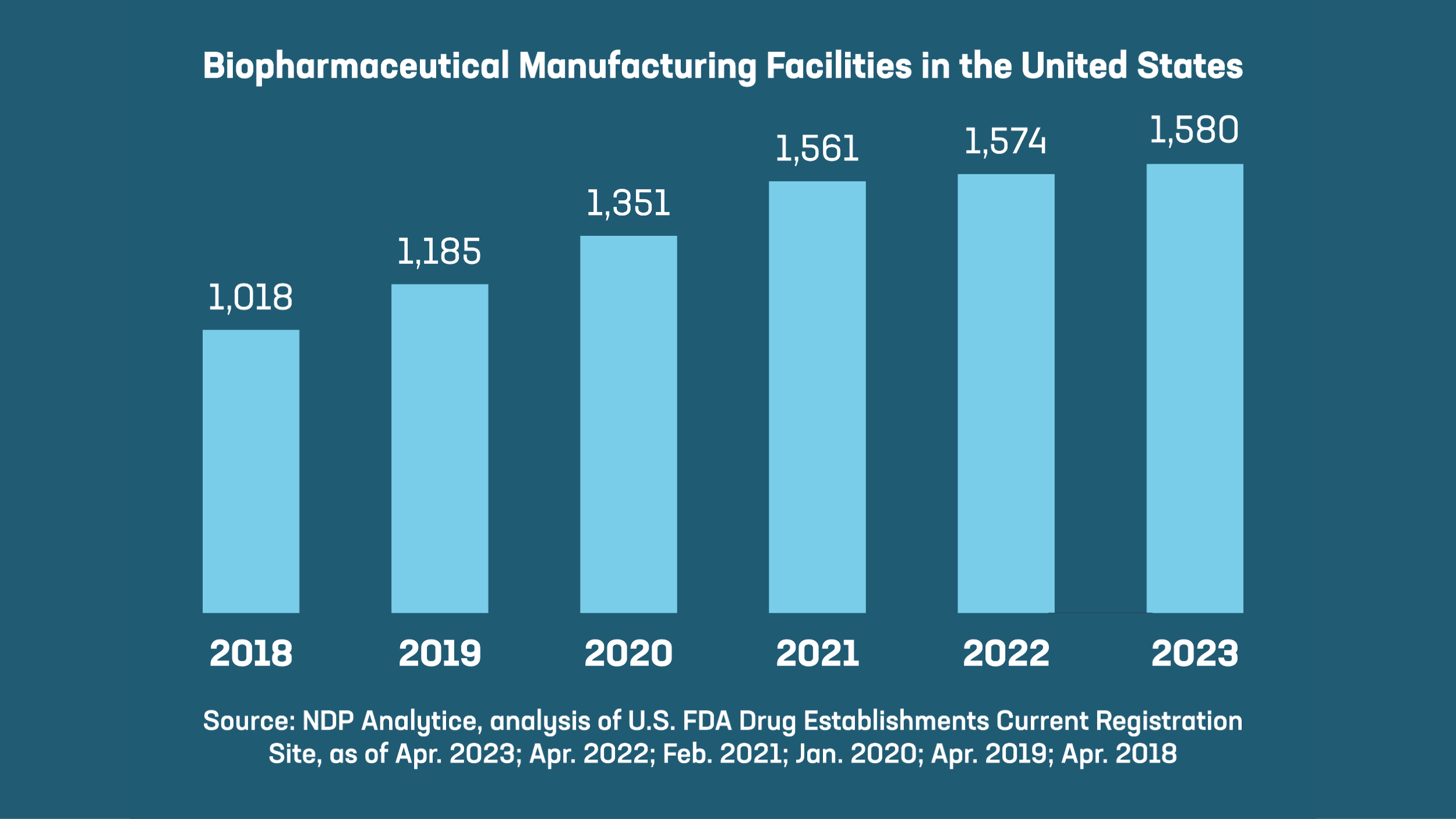
- As of April 2023, biopharmaceutical companies and their suppliers operated 1,580 production facilities across the country, in 48 states and Puerto Rico. Building just one facility can cost up to $2 billion and take five to 10 years before it is even operational, so this geographic reach and continued growth helps fortify the supply chains we all depend on and mitigate potential shortages or disruptions.
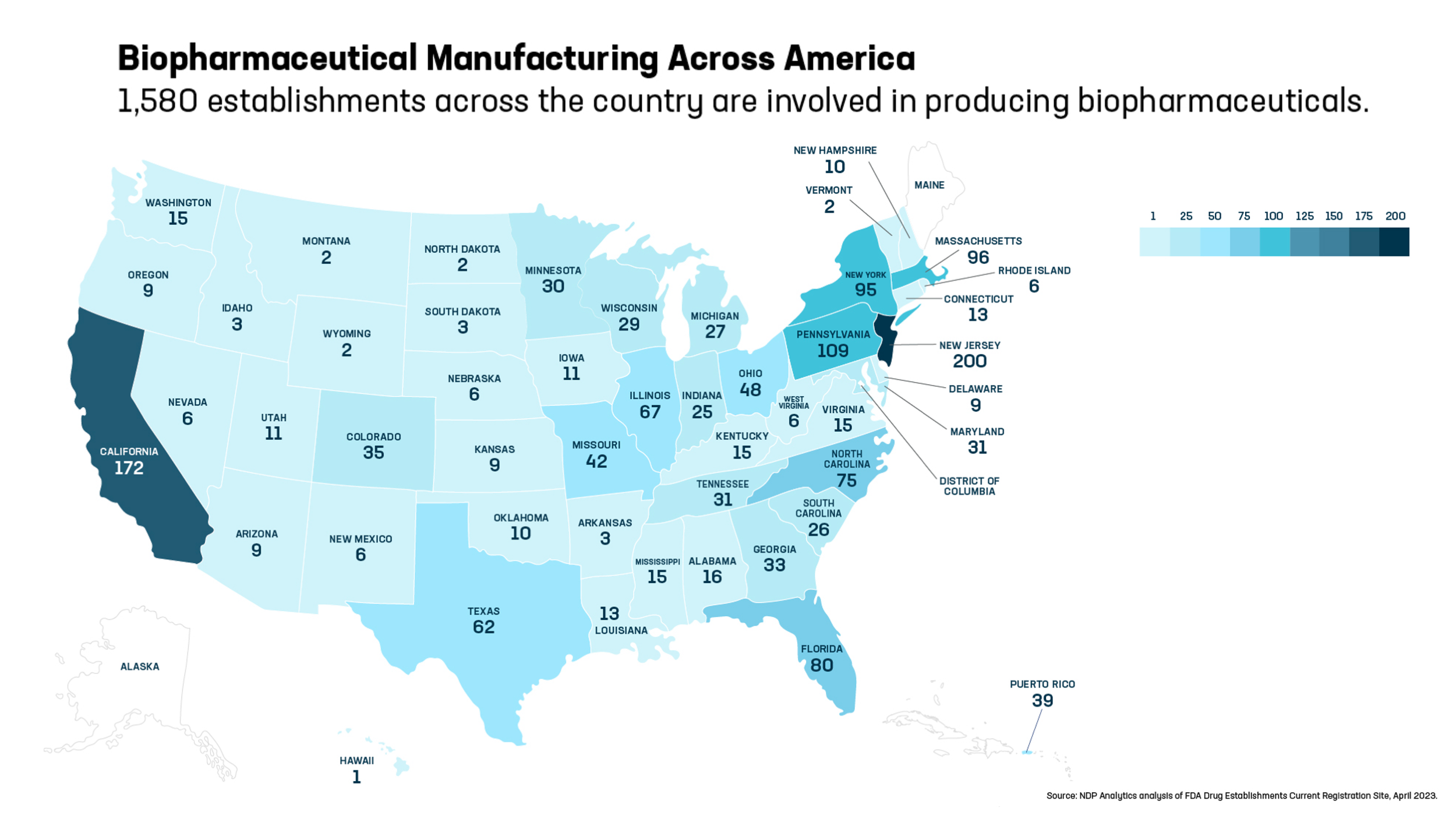
- Nearly 20% of these new facilities are manufacturing active pharmaceutical ingredients (APIs), which are the ingredients that produce a medicine’s intended health effects. While not the only part of the manufacturing process necessary to produce a medicine that can be delivered to patients, the production of APIs is an essential step in the process.
Investment in manufacturing in the U.S. helps to drive local economies, create jobs and boost American competitiveness. As companies add new manufacturing lines and expand existing lines to increase production capacity, their investments help ensure we continue to have resilient and secure supply chains to meet U.S. patient needs.
Click here to learn more about the role of manufacturing of biopharmaceuticals.
Tim McClung
Biopharmaceutical manufacturing companies continue to expand their economic footprint across the United States